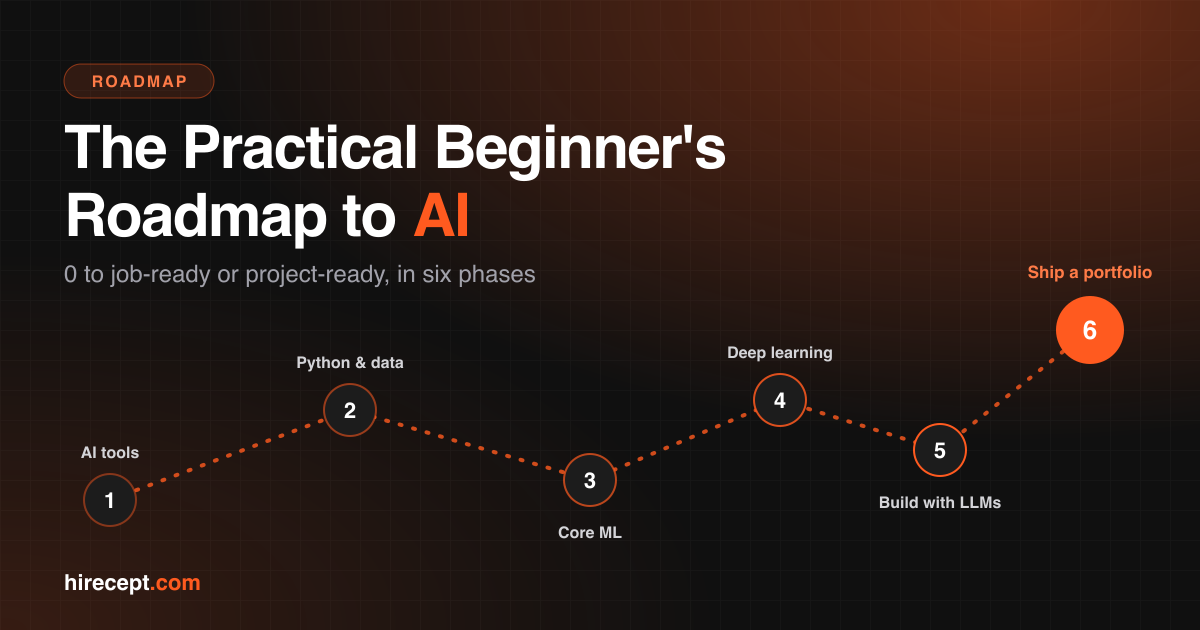
Most people who want to learn AI get stuck choosing where to start. This roadmap removes that choice. It is built around one idea: learn by building, not by watching. At every phase, spend about 30% of your time on theory and 70% on hands-on practice.
The time estimates assume 8–10 hours a week. At that pace you can reach a solid foundation in about 6 months and a portfolio in 9–12.
You don't have to do it alone, either. We share learning resources, hiring drives and openings every day in the Hirecept WhatsApp channel and the Hirecept Telegram group, so it's worth joining before you start.
Step 0: Pick your lane (30 minutes)
AI has three common paths. The early phases are shared, and you branch at Phase 4.
| Lane | You are... | You'll mostly do |
|---|---|---|
| A. AI User / Power User | Any profession (marketing, finance, teaching, etc.) | Use AI tools to work 3–10x faster, automate workflows |
| B. AI Builder / Engineer | Developer or aspiring developer | Build apps with LLM APIs, agents, RAG |
| C. ML / Research Track | Math-curious, wants depth | Train models, understand architectures |
Everyone should do Phases 1 and 2. Most people should aim for Lane A or B first. Lane C is optional and can come later.
For an overview, see the roadmap.sh AI Engineer path and Elements of AI, a free, non-technical intro.
Phase 1: Get fluent with AI tools (Weeks 1–3)
Goal: Use AI daily and see what it can and can't do.
- Use a frontier assistant every day: Claude, ChatGPT or Gemini. Try all three on the same task and compare.
- Learn prompting with these free guides:
- Try AI-assisted work in your field: research, writing, spreadsheets, coding help, image and voice tools, meeting notes.
- Take AI For Everyone by Andrew Ng to learn the vocabulary.
Checkpoint: You can explain the difference between AI, ML, deep learning, and generative AI, and you have 3 workflows where AI saves you time every week.
Phase 2: Python and data basics (Weeks 3–10)
Python is the language of AI. You don't need to be an expert, just comfortable.
Python
- CS50's Introduction to Programming with Python (free, excellent)
- Automate the Boring Stuff with Python (free, practical)
- Kaggle Learn: Python
Data tools
Environment
- Google Colab (free notebooks, no setup)
- Git and GitHub basics. Put everything you build on GitHub.
Math (just-in-time, not up front)
- 3Blue1Brown: Essence of Linear Algebra
- 3Blue1Brown: Essence of Calculus
- Khan Academy: Statistics & Probability
Mini projects: a script that cleans a messy CSV, and a notebook that analyzes a dataset you care about (sports, finance, your own spending).
Checkpoint: You can load data, clean it, plot it, and write functions without copy-pasting everything.
Phase 3: Core machine learning (Weeks 10–18)
Goal: Understand how models learn from data.
- The Machine Learning Specialization by Andrew Ng is the best structured start.
- The Google Machine Learning Crash Course is free and practical.
- Kaggle Learn: Intro to ML and Intermediate ML.
- The scikit-learn tutorials cover the standard library for classical ML.
Concepts to own: train/test split, overfitting, features, regression vs classification, evaluation metrics, cross-validation.
Practice: Enter a beginner Kaggle competition (start with Titanic or House Prices). Read the top public notebooks after your own attempt.
Checkpoint: You've trained, evaluated, and improved 3 models on real datasets and can explain why one beat another.
Phase 4: Deep learning and how LLMs work (Weeks 18–26)
Goal: Demystify neural networks and ChatGPT-style models.
- 3Blue1Brown: Neural Networks gives the visual intuition.
- Karpathy: Neural Networks, Zero to Hero builds everything from scratch, up to a GPT.
- fast.ai Practical Deep Learning is top-down and code-first.
- Hugging Face Learn covers LLM, NLP, and agents courses, all free.
- The PyTorch tutorials.
- Optional depth: Build a Large Language Model (From Scratch) and Stanford CS224N.
Checkpoint: You can explain tokens, embeddings, attention, pretraining vs fine-tuning, and why models hallucinate.
Phase 5: Build with LLMs (Weeks 20–32, overlaps with Phase 4)
This is where most practical AI careers and income are today.
Core skills
- Call an LLM API from code. See the Anthropic docs and OpenAI docs.
- Structured outputs and tool use (function calling).
- RAG (Retrieval-Augmented Generation): chat with your own documents. Learn embeddings and vector search with LlamaIndex or LangChain.
- Agents: LLMs that plan and use tools. See Anthropic's Building effective agents and the Model Context Protocol.
- Evaluation: how you know your app works. Write test cases before shipping.
- Run models locally with Ollama and open models on Hugging Face.
Courses
- DeepLearning.AI Short Courses are free, 1-hour, and hands-on.
- Anthropic courses on GitHub
- Full Stack LLM Bootcamp
Ship UIs quickly: Streamlit, Gradio, and Hugging Face Spaces for free hosting.
Checkpoint: You have 2 deployed apps with public URLs.
Phase 6: Portfolio and proof (Weeks 26–40)
Employers and clients care about shipped work, not certificates.
5 portfolio projects (pick 3–4)
- Chat with your documents: a RAG app over PDFs, with source citations.
- Workflow automation agent: reads email or Slack, drafts replies, files tasks.
- Domain assistant: a tool for one niche (legal clauses, recipes, fitness, customer support).
- Classical ML project: an end-to-end prediction with a clear business framing.
- Evaluation harness: compare 3 models on a task with real metrics and charts.
Habits that signal seniority
- A README that explains the problem, approach, results, and limitations.
- A short demo video or live link.
- Write-ups on LinkedIn, Medium, or a blog. Teaching is the fastest way to learn.
- Join Kaggle, Hugging Face, or a local AI community and contribute to open source.
Once you have a project or two on GitHub, share them with other learners in the Hirecept LinkedIn group and ask for feedback. Posting your work where recruiters and peers read is the quickest way to get noticed.
Staying relevant (ongoing, 2–3 hours a week)
- Newsletters: The Batch and Import AI
- Papers: Hugging Face Daily Papers and arXiv cs.AI. Read abstracts, and deep-read one paper a month.
- Responsible AI: AI Safety Fundamentals covers bias, privacy, security, and misuse.
- Rebuild once a quarter. Tools change fast, so re-do one old project with the newest models and see what's now easier.
Preparing for the AI world, by lane
Lane A (non-technical professional)
- Do Phase 1 deeply, then automate your own repetitive tasks (no-code tools like Zapier or Make plus LLMs).
- Build a personal "AI playbook" of prompts and workflows for your job.
- Your edge is domain expertise plus AI, so go deep on your field.
- If you want to put that edge to work for companies abroad, start with the remote jobs on Hirecept and watch the WhatsApp and Telegram groups above, where new remote openings are posted as they appear.
Lane B (builder)
- Phases 1, 2, 5, and 6 are your core. Pick up Phases 3 and 4 as needed.
Lane C (ML/research)
- Add linear algebra, probability, and optimization, then Stanford courses and paper reproduction.
Weekly rhythm (works for any phase)
| Day | Activity |
|---|---|
| Mon–Tue | Learn (course or reading), 1.5 hrs each |
| Wed–Thu | Build or practice (notebooks, project), 2 hrs each |
| Fri | Review and write a short note on what you learned |
| Sat | Longer project block, 3 hrs |
| Sun | Rest, plus 20 minutes of newsletters |
Common beginner mistakes
- Tutorial hell: finishing course after course without building. Fix: ship a project every month.
- Math paralysis: waiting to "master" math first. Learn it just-in-time.
- Chasing every new tool: master fundamentals (APIs, data, evaluation) and tools become easy to swap.
- Trusting AI output blindly: always verify facts, code, and numbers.
- Learning in isolation: share your work publicly and ask for feedback.
Quick checklist
- Use an AI assistant daily
- Python and pandas comfortable
- Trained and evaluated ML models
- Understand how LLMs work conceptually
- Called an LLM API and built a RAG app
- 3+ projects on GitHub with READMEs
- 1+ deployed public demo
- Following 2 newsletters and reading papers monthly
If you only do three things
- Use AI tools daily.
- Learn Python.
- Build and ship small projects consistently.
Everything else in this roadmap supports those three. Pick your lane, start Phase 1 this week, and ship something small before the month is out.
Ready for the basics? Start applying
You don't need to finish the whole roadmap before you start applying. Once you are comfortable with the basics (an AI assistant in your daily work, some Python, and one or two small projects on GitHub), you are ready to apply for entry-level and internship roles. You can quick apply to jobs on Hirecept in a few clicks, then keep learning while you wait to hear back. For daily openings and remote roles, keep an eye on the WhatsApp channel and the remote jobs page.